

Do Care Providers Like Point Of Service Plans
When choosing health insurance for your company, there are many decisions to make. One of the first may be what type of program to choose.
If you lot're looking for health insurance, you've probably come across the acronyms HMO, PPO, POS, and EPO. That'southward a lot of messages in one place. Here's what each stands for:
-
HMO: Health Maintenance Organization
-
PPO: Preferred Provider Organization
-
POS: Point of Service
-
EPO: Exclusive Provider Organization
Agreement the differences betwixt these options is an important first footstep to determining which kind of plan is right for your company and employees.
Looking for more help deciphering health insurance terms? Download the ABCs of Health Insurance ebook for guidance.
Defining HMO, PPO, POS, and EPO Insurance
To begin, here's a general overview of the differences betwixt these four plans. We'll break down these differences in more detail later in the mail.
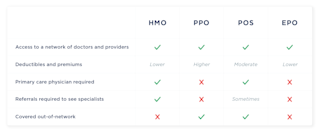
Let's break downwards how each is structured.
HMO: Wellness Maintenance Organizations
HMOs begin past establishing a local network of doctors, hospitals, and other providers. The providers agree to accept payment at lower rates for the services they provide to programme members, which sets costs and keeps them in check. HMO plans typically require patients to accept referrals from a primary care physician, and won't cover out-of-network care.
PPO: Preferred Provider Organizations
PPOs as well offering access to a network of doctors and providers who have payment at a certain rate for members. However, different an HMO, a PPO allows patients to access handling from providers outside of the network. In other words, members of a PPO can see any doctor they want or visit any hospital, although providers exterior of the network will tend to cost more. Patients are as well not required to choose a single primary care physician, and practice not need a referral to see specialists.
POS: Point of Service
POS provides in-network care like HMO, merely also allows patients to receive out-of-network intendance under certain circumstances. POS plans are typically gated, pregnant a member must choose a principal care md who is the "point of service." However, this is non always the case.
Every bit with Preferred Provider Organizations or whatever other plans covering both in- and out-of-network services, if yous choose to access healthcare services from providers exterior of your network, you'll have higher out-of-pocket costs, and not all services may be covered.
While similar to HMO, POS plans provide more than geographic flexibility (as well as out-of-network benefits).
EPO: Exclusive Provider Organizations
EPO likewise provides access to a network of providers. Like HMOs, these plans do not pay for out-of-network care (except in some emergency circumstances). Unlike HMOs, EPOs usually do not require patients to select a chief care physician and do non require referrals to encounter specialists.
The ABCs of Health Insurance
Tin't keep upwards with all the health insurance terms out there?
Cost of HMO, PPO, POS, and EPO Insurance
Toll is a major cistron in choosing between plans. While every plan differs, in general, the more flexibility a plan offers — east.chiliad., covering some percentage of out-of-network intendance or allowing patients to see a specialist without a referral — the more it volition toll in terms of premiums and price-sharing (eastward.g., deductibles, coinsurance, and copayments). The less flexibility, the less expensive.
HMOs and EPOs tend to have lower monthly premiums. Since the in-network providers all hold on the pricing level for their services, this helps the HMO/EPO to keep costs depression.
These plans also tend to have lower copays and coinsurance than other health insurance plans. However, it'southward important to think that these lower costs are gained past using in-network providers.
Related Article: 3 Questions To Ask Before Picking Your Company'south Wellness Insurance
In part due to their out-of-network benefits, POS plans typically come up with slightly higher premiums. PPOs, which give members the most choice in terms of which providers they see, oft have all the same higher monthly premiums and copays. They besides nearly ever have an annual deductible, or an corporeality the insured fellow member must pay out-of-pocket before the insurance plan kicks in and pays any claims. HMOs, EPOs, and POS plans oft accept no deductible or a low deductible.
That said, PPO members tin save money past seeing doctors that are inside the PPO network, as out-of-network providers will more often than not toll more.
Primary Care Physicians (PCP) and Referrals
Equally mentioned before, one fundamental difference between these different healthcare plans is whether they require members to choose a primary care physician (PCP) to manage their overall intendance.
Many HMOs crave members to choose a PCP to manage their overall care. The PCP must exist in the HMO's network, and this doctor will be the provider you encounter whatsoever fourth dimension y'all need medical handling.
If you demand to see a specialist, yous would offset visit your PCP, who would then refer yous to an in-network specialist. Or, to put information technology some other style, you lot may not be covered for a visit to a specialist without that referral from the PCP commencement. Still, the HMO provides an affordable option and can be adept for people who don't mind using a PCP to manage their care.
HMO provides an affordable option and can be good for people who don't mind using a PCP to manage their care.
POS plans also typically require members to choose a PCP. Some POS plans require referrals from this PCP to meet specialists, merely others are "open access," meaning that patients exercise non need referrals.
Both EPOs and PPOs exercise not crave members to cull a PCP, and they don't require referrals to see specialists. PPO members tin encounter any doctor or provider they similar, in- or out-of-network.
The flexibility of POS and PPO is nice for people who already take a doc they like, since they won't have to switch to ane in-network. It'southward also helpful for people who travel and desire coverage, because members can see doctors outside of their local network equally needed.
Related Article: Should Small Businesses Offer Dental and Vision Insurance?
The Bottom Line: Selection What Fits Your Team
Retrieve that every health insurance program varies. Information technology'due south of import to carefully review each one as information technology pertains to your teams' needs.
If you and your employees want plans that prioritize lower toll, HMO or EPO insurance may be a good fit, particularly if people just want basic medical intendance.
If your employees prefer more choices for care and don't mind paying more than for it, a PPO tends to offer greater flexibility. POS plans can offer the best of both worlds, with access to a national network of providers at rates more competitive than HMO or EPO plans.
If you're looking for affordable health insurance for your team, Justworks tin help. Take a wait at our benefits and explore the plans we offer access to.
This material has been prepared for advisory purposes only, and is not intended to provide, and should not be relied on for, legal or revenue enhancement advice. If you accept whatever legal or taxation questions regarding this content or related bug, then you should consult with your professional legal or tax counselor.

Source: https://justworks.com/blog/breaking-down-difference-between-hmo-ppo
Posted by: hopewitinithey41.blogspot.com
0 Response to "Do Care Providers Like Point Of Service Plans"
Post a Comment